IPHO TUTOR · CONTENT, SEARCH & BRAND · 2022–2026
WORK № 07IPhO Tutor Website
The content nobody else had
物奧土魠 was a new physics olympiad tutoring brand. Its website came to rank near the top when students in Taiwan search for olympiad past papers. It runs on Google Sites; what got it there was the content, which filled two gaps. No site collected Taiwan's official papers in full, and almost nobody had written complete solutions to them.
WHAT NOBODY ELSE HAD — EVERY YEAR PAGE, 1994–2025
物奧土魠 IPhO Tutor - 2024 物理奧林匹亞複選題目和詳解 | 物奧複選試題與解答
Open on ipho-tutor.com ↗- A year page on ipho-tutor.com
- With video solutions
- With handwritten solutions
- Not listed on the hub — reached through the selector
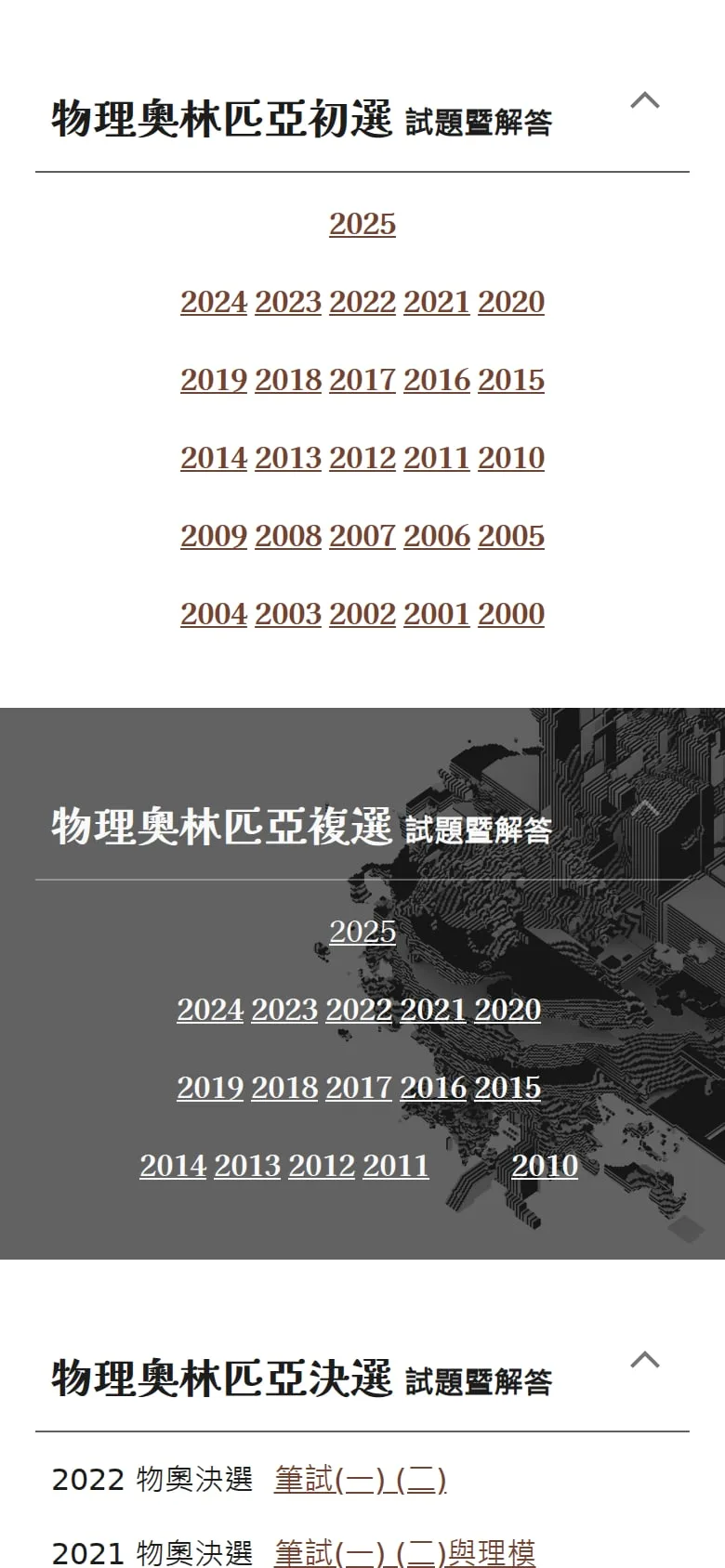
Taiwan's official papers, all three rounds, each year on a page of its own — 26 first-round, 32 semi-final and 12 final pages, as live on 6 October 2026. The marks show where the video and handwritten solutions are. Hover or tap a page for its title.
- DATE
- 2022 – today · the earliest logo file is from March 2022, the earliest archived copy of the hub from August 2022
- CONTEXT
- My own physics olympiad training company, 物奧土魠 (IPhO Tutor). This is its public website.
- ROLE
- Content strategy · Information architecture and SEO · Collecting the papers · Written and video solutions · Brand visuals
- STACK
- Google Sites · Google Drive · OneNote · YouTube · Midjourney · Photoshop · an HTML and JavaScript embed for the selector
THE 45-SECOND READ
What a student could practise on depended on their school or teacher. No website collected Taiwan's official olympiad papers in full — the semi-final and final least of all — and almost nobody had systematically written complete solutions.
DECISIONDon't start by building a better website. Fill both gaps fast, on the tool that was cheapest to fill and keep up — Google Sites, with Google Drive — and plan every page so that a student's search lands on it.
PRODUCTA hub of past papers — 70 pages for Taiwan's first round, semi-final and final; seven other olympiads, the IPhO among them, linked by year; and handwritten and video solutions for recent rounds.
STATUSLive. For 物奧考古題 it was often the first result that wasn't an official one, and its growth came almost entirely from organic search, not ads. Some content was later taken down after I reconsidered copyright.
This isn't simply a web design project. It starts from a pain point students had, and uses content, information architecture, SEO and brand design to turn a gap in educational resources into a chance to grow a product and a brand.
ON THE PROJECT
THE PRACTICE / 01 · THE BET
Content first, the website second
I first noticed the gap in 2016, when I took part in the physics olympiad selection myself. Some schools and teachers had complete sets of past papers, solutions and training material; some students struggled even to collect a full set of past papers. For a national competition, that affects how fair it is.
We had long wanted a site of our own, but our technical skills weren’t enough, I had little experience building websites, and upkeep, file management and cost all had to be thought through — so it never went live. In the end I didn’t start from wanting an impressive website. For me at the time, being able to put complete content up quickly mattered more than building a beautiful site from scratch that would be hard to maintain.
Google Sites wasn’t the strongest choice visually or technically. It fitted the actual problem: a large pile of PDFs, images and videos, and not every problem worth a video of its own. It costs little to maintain and works directly with Google Drive, so the material we already had could quickly become something anyone can browse.
THE PRACTICE / 02 · GAP ONE, THE PAPERS
Every paper I could find, in about three days
When the site went up, I started with what had the most search demand and the least organisation online. In about three days I gathered the past olympiad papers I could find into one place, and set them out in the way I thought was easiest for a student to use: one page for each round of each year.
Beyond Taiwan, the hub lists seven international olympiads by year — 519 links to the question and solution files on Drive. The Pan Pearl River Delta olympiad is the exception: for copyright reasons, it points to the organiser’s own site.
THE PRACTICE / 03 · GAP TWO, THE SOLUTIONS
Solutions laid out like a whiteboard
The papers alone weren’t enough; almost nobody had complete solutions. Almost all of the videos and handwritten solutions on the site are my own, and the way they look comes from physics classes I’d sat in.
The teacher would often use four large whiteboards that slid up and down. A formula or a derivation might start in the top-left corner; five or ten minutes later the working had reached the bottom-right, and the earlier board could still be pulled back to check which assumption, formula or picture had been used. Understanding physics depends on space and position — I remember that the formula was top-left, that the diagram sat to the right of the derivation, that this step uses that earlier result. Turn it all into one long waterfall of text and the reader keeps scrolling back to find things — effort that has nothing to do with the physics.
So I use OneNote and tools like it to give a solution a larger visual space, where a student can see how the formulas, the diagrams and the steps of the derivation sit in relation to each other.
GAP TWO / ONE PAGE, READ AS A BOARD
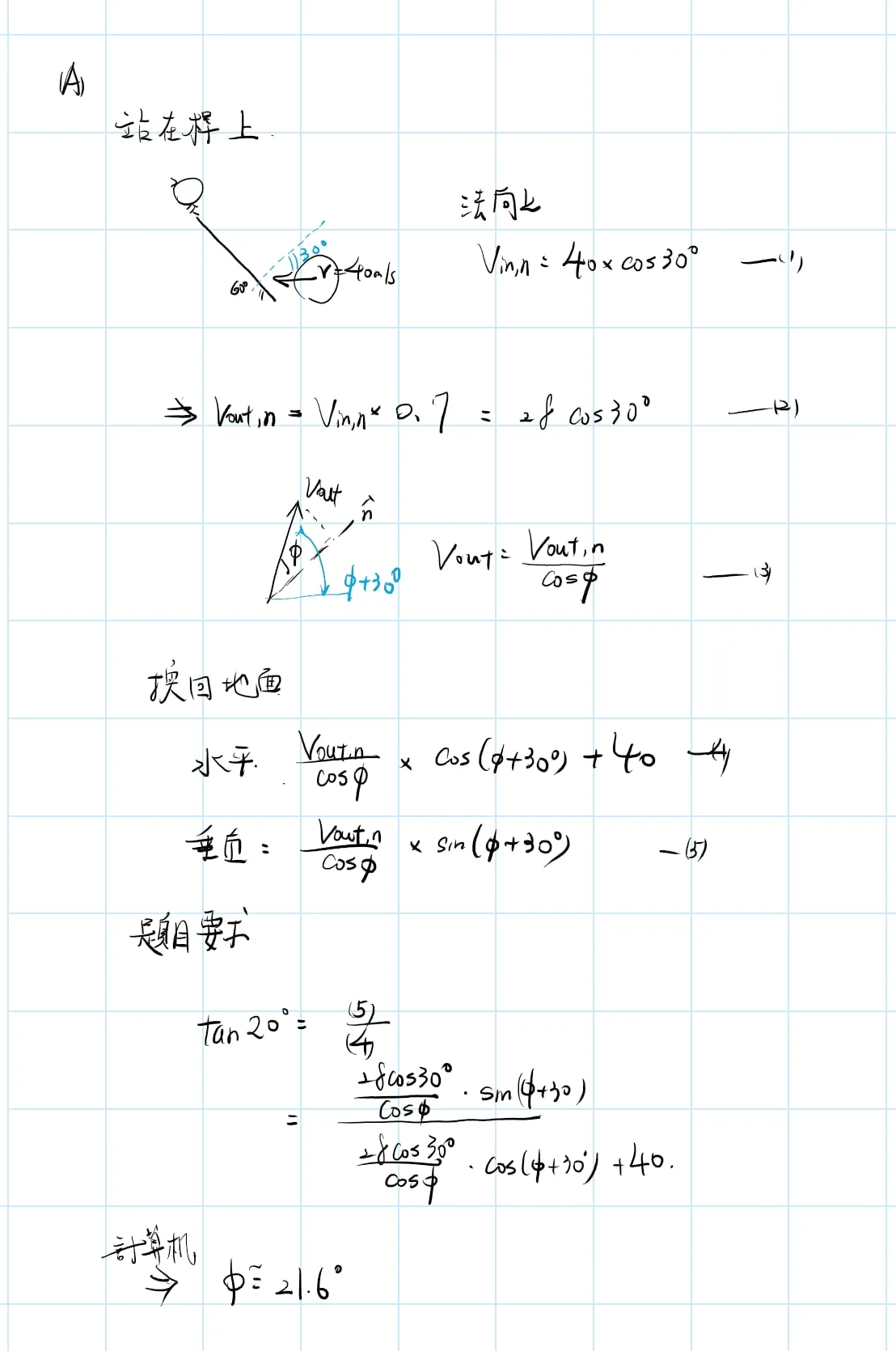
- 01The sketch beside its equation
In the club's frame, the drawing of the incoming ball sits right next to the equation it gives — the normal component of its velocity, (1).
- 02Numbered at the edge
Results are numbered (1) to (5) down the right-hand side, so a later line can point back to them.
- 03A second sketch, where it's needed
The outgoing velocity and its angle φ are drawn beside (3), the equation that uses them.
- 04Pointing back, not copying out
The condition the question sets is written as tan 20° = (5)/(4) — the two speeds from the lines above, by number.
GAP TWO / THE YEAR PAGE
Solutions first, the paper below
Solutions come first. The paper sits below them, so visitors who only want the paper stay on the site too — but I didn’t want the whole set packaged up and carried off in one go, which would cut how long people stay.
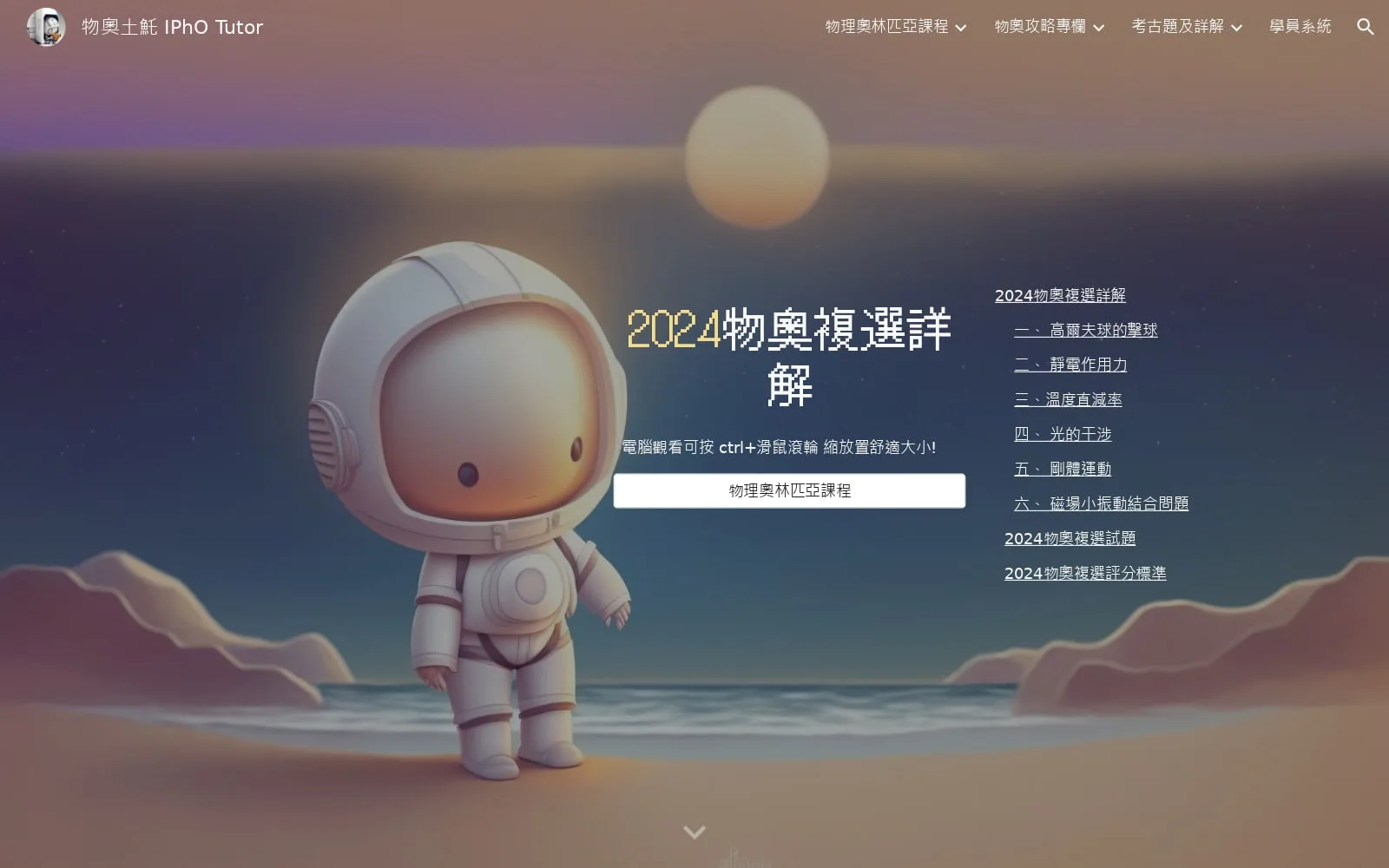
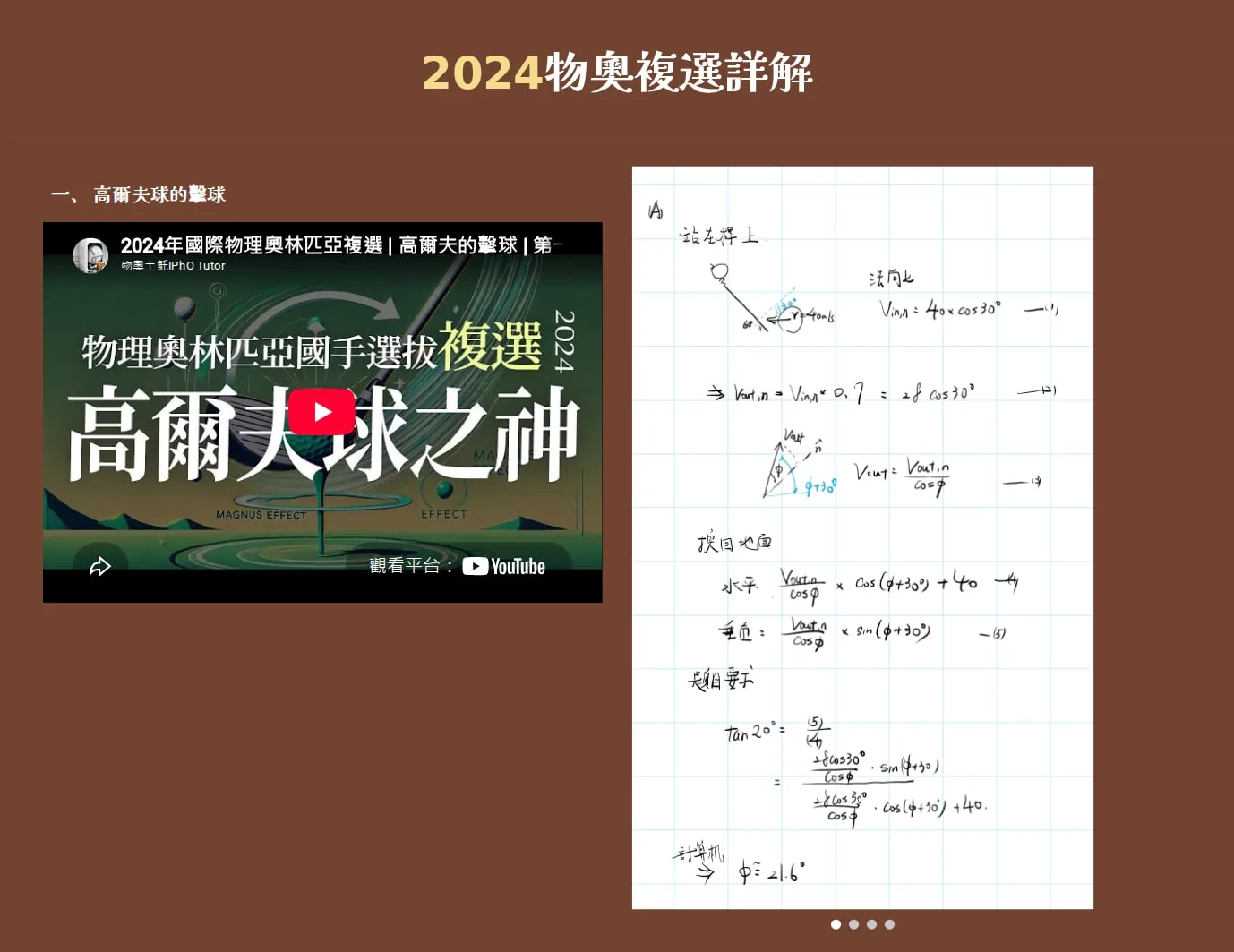
What a year page holds — the 2024 semi-final, top to bottom.
 01
01The year, and what's on the page
The page opens on its year and round, a contents list of the six questions, the paper and the marking scheme — and a button to the course.
 02
02Solutions, on brown
Each of the six questions has a video and handwritten pages side by side. The first page of question 1 is the one taken apart above.
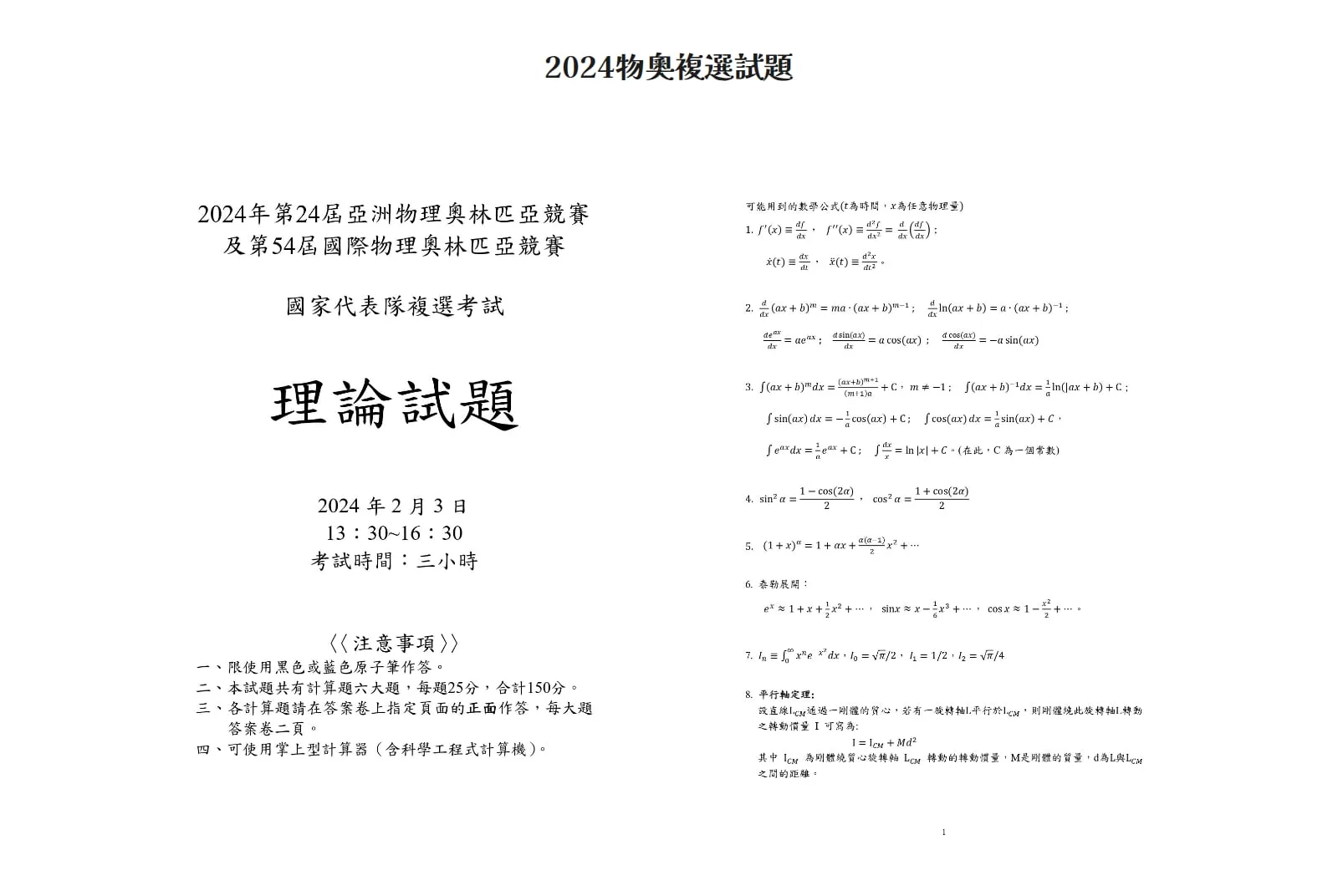 03
03The paper, on white
The official paper, below the solutions, page by page, as images on the page itself.
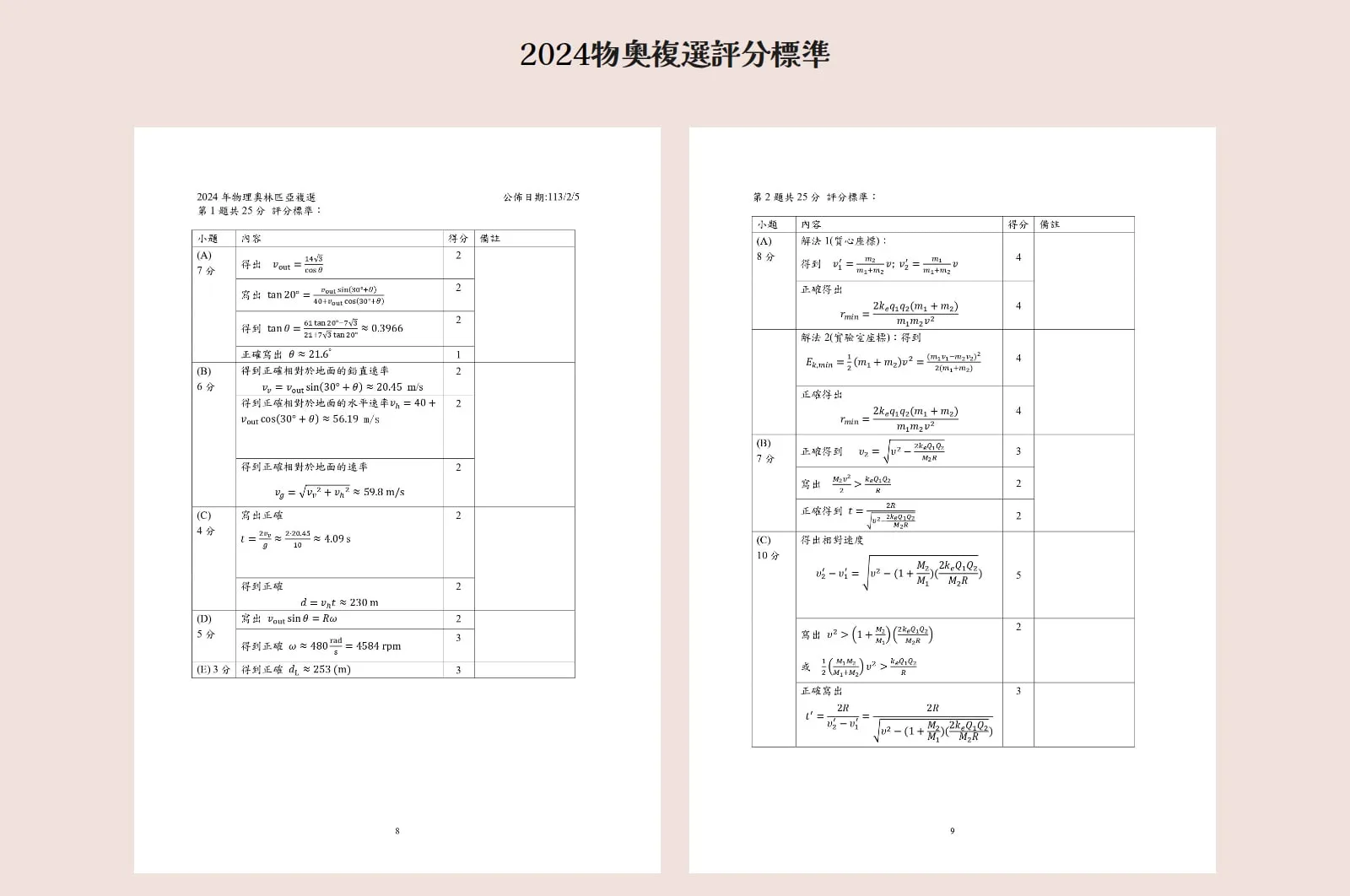 04
04Marking, on pink
The official marking scheme, shown the same way. Each part of the page has its own band colour.
THE PRACTICE / 04 · MADE TO BE FOUND
One address for each paper
The aim was simple: when a student searches 物奧考古題, they should find us first. That meant deciding how to plan the addresses so a search engine could read the site’s structure; what to gather in one place and what to split into pages of its own; what a student arriving from a search should see first, without being pulled away by everything else; and how to balance the brand’s key visual against the working content.
For Taiwan’s papers the answer is one page per round per year, each at an address built from the same parts. Every page title carries both 物奧 and a longer form, 物理奧林匹亞 or 物理奧匹, and both 題目 and 試題. The addresses weren’t always like this: in August 2022 the hub was at /olympiad-problems, and in February 2023 a year page sat at /免費の資源/olympiad-problems/….
MADE TO BE FOUND / THE PATH, AS PLANNED
01 · Search
物奧考古題The search I wanted students to find us by.
02 · The hub
/tpmso-org/olympiad-problems物奧土魠 IPhO Tutor - 物奧考古題 | 物理奧林匹亞試題
A selector at the top, then a section for each competition.
03 · The rounds
- 初選First round26
- 複選Semi-final32
- 決選Final12
One page per year. Sixteen semi-final years aren't listed on the hub and are reached through the selector.
04 · One year page
…/tpmso-physics/複選/2024-semi-final-selection-answer-and-solution物奧土魠 IPhO Tutor - 2024 物理奧林匹亞複選題目和詳解 | 物奧複選試題與解答
Solutions, then the paper, then the official marking scheme — and a button to the course.
Addresses and page titles as served on 6 October 2026. The marked words are the search terms in each title.
THE PRACTICE / 05 · MADE INTO A BRAND
From a hand-drawn logo to a character
Beyond the site, another big part of the project was the look of the 物奧土魠 brand. The first logo was one I drew myself: a simple line drawing, close to a stick figure or a chibi character, with 物奧土魠 beside it. I wanted it to feel like a real brand, not just a tutoring website.
When image generators matured, I used Midjourney to make visual material and found directions I wouldn’t have reached by drawing on my own. The astronaut came out of that. For me the project was also about letting the teaching material, the site, the character and the visual language grow into one brand.
MAR 2022
LOGO.png — the first logo file
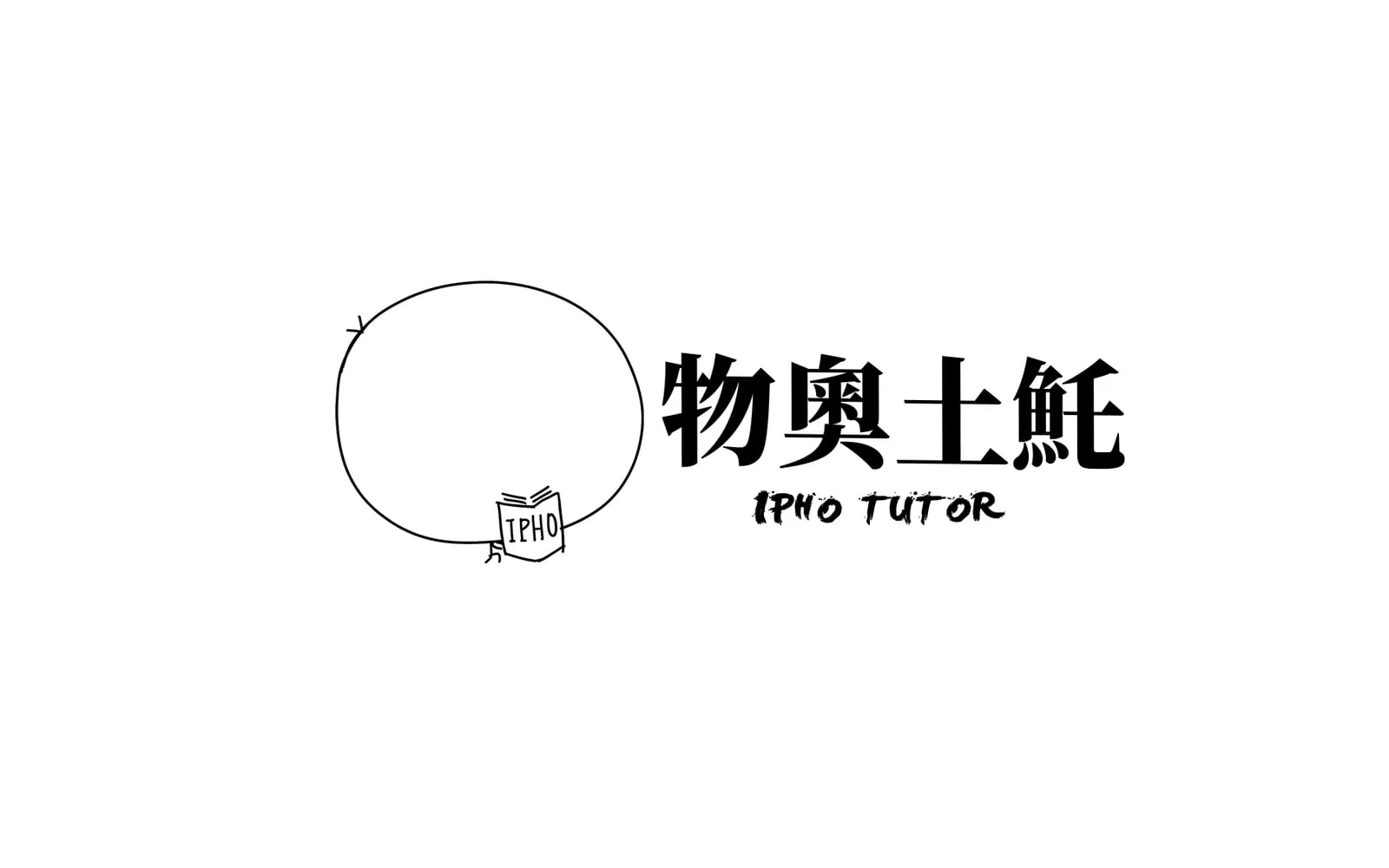
The logo file, dated 19 Mar 2022
- The first logo
Drawn by hand — a tiny figure carrying a book marked IPHO, at the foot of a big circle. The file is dated March 2022.
JUL 2023
/tpmso-org/olympiad-problems
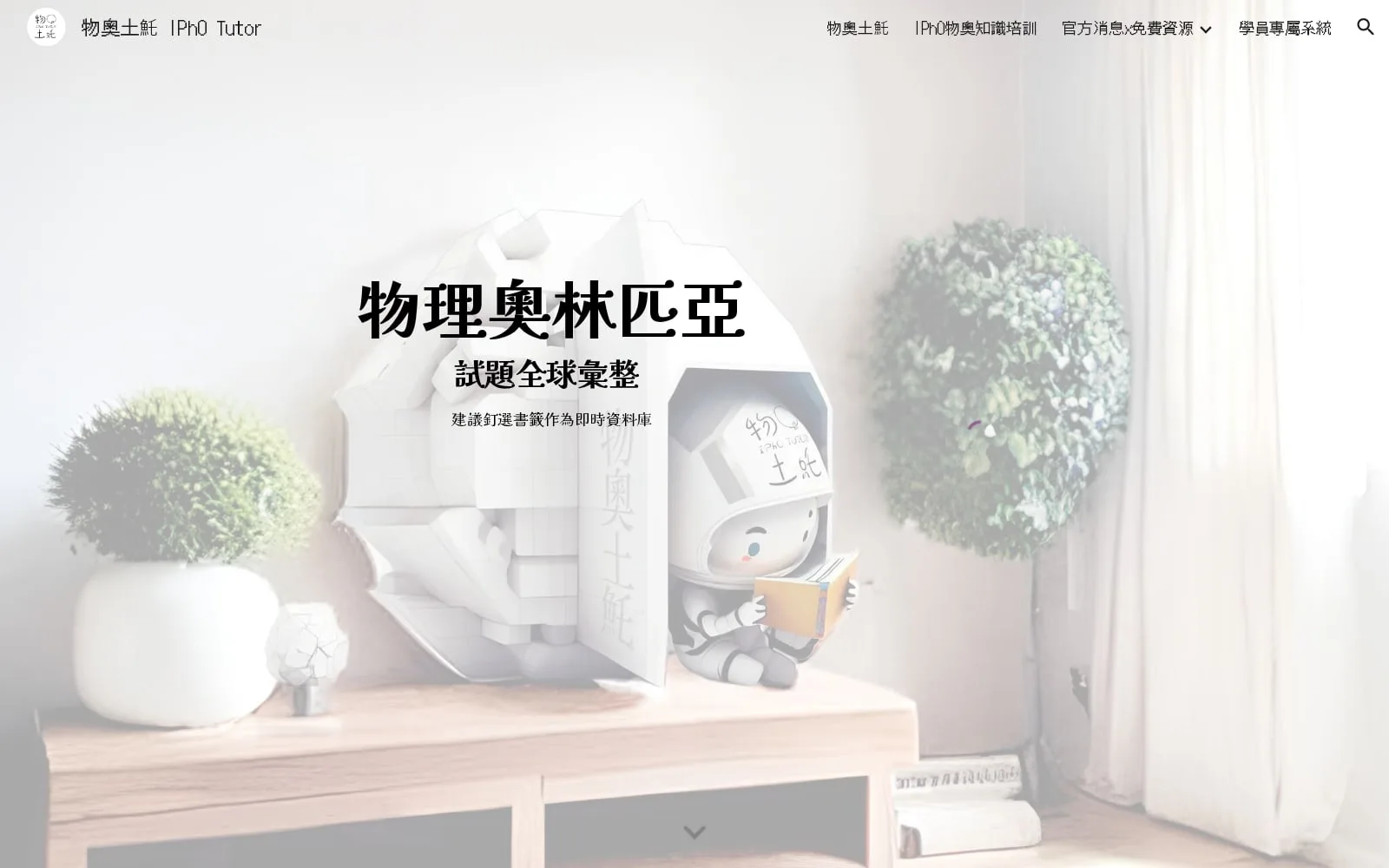
Internet Archive, 31 Jul 2023
- The astronaut
Made with Midjourney — a small astronaut reading in a pale room. The character also appears on the covers of the course handbooks.
OCT 2026
/tpmso-org/olympiad-problems
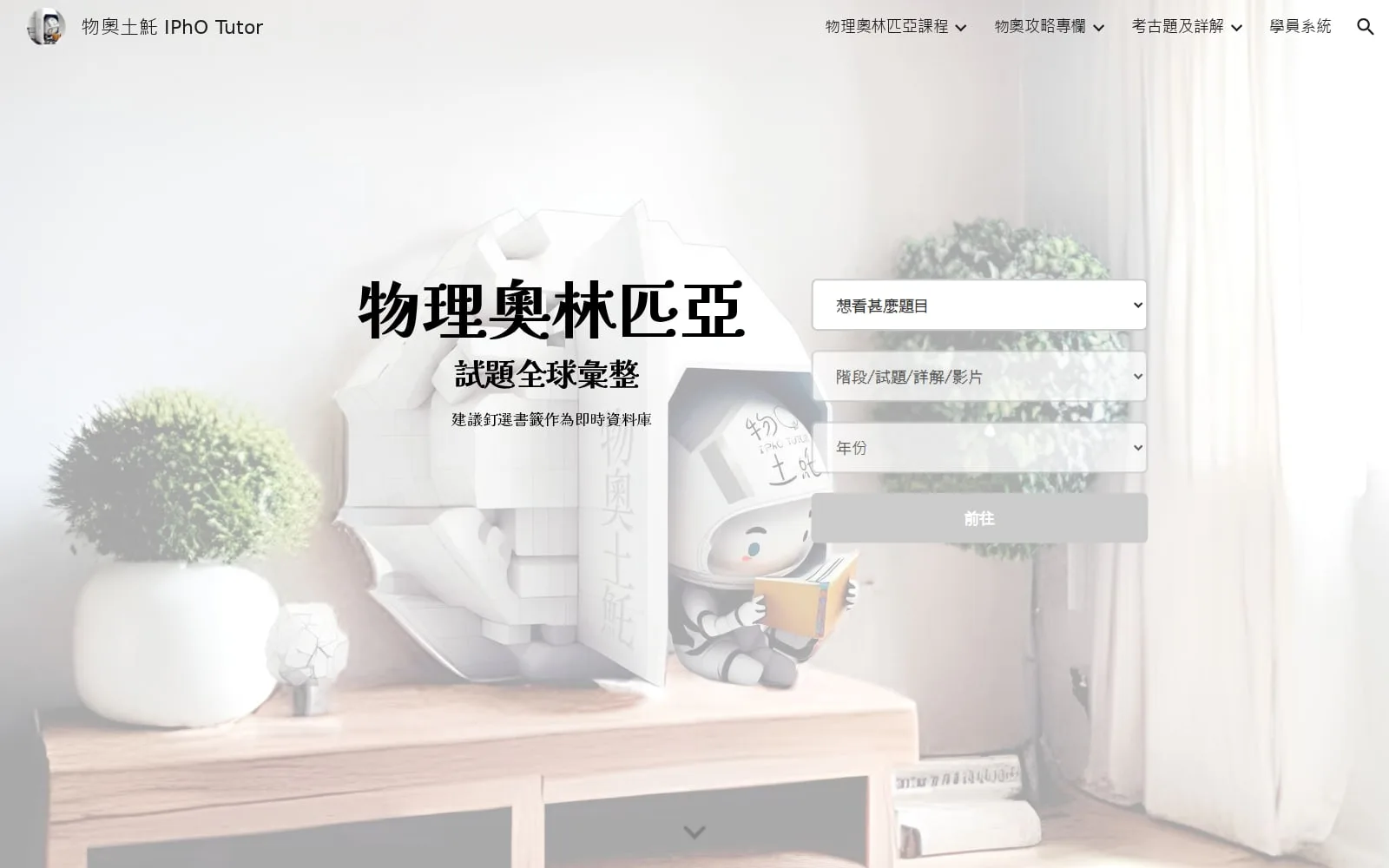
The live site, 6 Oct 2026
- The selector
Three menus beside the title go straight to a year page — the copy above works the same way.
The first logo file, then the top of the hub in July 2023 (from the Internet Archive) and October 2026. In the 2023 copy only a loading icon sits where the selector is today.
THE PRACTICE / 06 · WHAT IT BECAME
Found first — then deciding what to keep public
The strategy worked quickly. For many olympiad searches the site has long ranked near the top, after Taiwan’s official olympiad site; for 物奧考古題 it was often the first result that wasn’t an official one. Its growth came almost entirely from organic search, not ads: complete papers and solutions brought search traffic, the traffic brought students to the brand, and the brand turned into real business. I didn’t keep complete Analytics or Search Console data from the period, so the rankings are my own account, not exported data.
Later I took some content down myself, after reconsidering where the copyright lines were. Once the site had grown, the question was no longer only whether the content was complete, but which of it should stay public for the long run, and what the brand should take responsibility for.
READING NOTE / VISIT
The site is live.
In Traditional Chinese. The year pages show the official papers and marking beside my solutions.